Sabtu, 03 Maret 2012

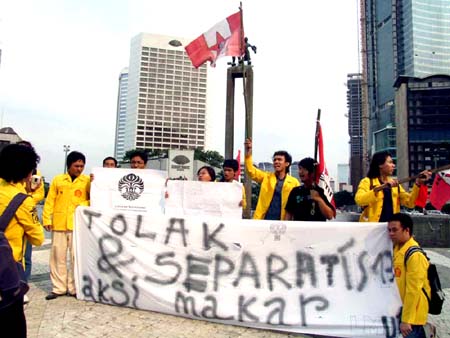
SEPARATISM

                                                                       
Separatism is a movement to obtain sovereignty and split a territory or group of people (usually the group with a keen national consciousness) from one another (or another country). The term is usually not accepted by the separatists themselves because they consider it rude, and chose a more neutral term sepertideterminasi themselves.

At its heyday, nationalism seems so deeply rooted in various walks of life in Indonesia. This can be easily seen in so many words 'my nation, my country, which I love' or 'for the sake of national and state', as it appears in almost every daily conversation to official state dialogue. Make sense of Indonesia, in the context of nationalism, is a unity between the nation (nation) as well as the state (state) (Dhakidhae, 2001: v). In it there is a solidarity of the nation-state (nation-state) from a wide arrangement of the tribal solidarity (ethnic). A great mystery behind the unification of diverse cultural entities that are very heterogeneous in an umbrella called the nation-state of Indonesia, have become commonplace in the national life. The slogan "Unity in Diversity", seems to be the ultimate adage that is able to reduce all the differences.


However, the emergence of various social conflicts in the era of the 1990s, seems to be a turning point in the journey of nationalism in Indonesia. After nearly half a century of triumphs in the archipelago of the earth after its independence, Indonesia nationalism seemed to crumble away without rest. Sense of pride as a unity of Indonesia seems to disappear, eroded by the waves of the spirit of tribalism and regionalism that was raging in some areas. Association of Indonesian nationality becomes less meaningful, and sunk by a very strong ethnic sentiment. The emergence of various shades of ethnic conflict, religion, and race (SARA) in Kalimantan, Maluku, and Poso, until a local revolt radical movement in East Timor, Aceh, South Moluccas, and Papua seems to be evidence of a fading sense of nationhood as well as a threat to the existence of Indonesia as a unified entity in a nation-state. Discourse of cultural separatism, anti-nationalism, Indonesia has become a phenomenon at once the question that kept looming. Could it be, nationalism, Indonesia has ended?

Examples of modern separatist movements in Indonesia is
• Republic of South Moluccas
• Free Aceh Movement
• Free Papua Organization

When examined, the emergence of separatist movements in Indonesia such as the GAM in Aceh, Maluku and RMS at OPM in Papua driven more by economic injustice felt by the people in these areas due to the failure of the Government in their welfare. In fact, such as in Aceh and Papua, natural resource wealth is overwhelming. Unfortunately, the wealth was enjoyed by more people and a handful of foreign companies.
Economic injustice as a trigger separatist movement has also been recognized by the Government. Vice President Jusuf Kalla, for example, has said that separatist movements in Aceh Darussalam (NAD), Papua, Republic of South Maluku (RMS), and the problem of Poso in Central Sulawesi unfinished up to now and the issue of terrorism is caused by economic injustice. Therefore, the firm Jusuf Kalla, the key to solve these problems is to create economic justice, in a sense, the welfare of the people of Indonesia must be truly realized. (Suarapembaruan.com, 23/11/05).


Jumat, 02 Maret 2012

The History of the FIFA World Cup

The History of the FIFA World Cup started in 1928, when FIFA president Jules Rimet decided to stage an international football tournament. The first competition, in 1930, consisted of just the final tournament of 13 invited teams. The competition has subsequently expanded to a 2 year qualifying process involving almost 200 teams from all over the world.
The first international football match was played in 1872 between England and Scotland, although at this stage the sport was rarely played outside Great Britain. An expansion in international football led to FIFA being formed in May 1904, comprised of football associations from seven continental European countries. As football began to increase in popularity, it was held as a demonstration sport (with no medals awarded) at the 1900, 1904 and 1906 Summer Olympics before football became an official competition at the 1908 Summer Olympics. Organised by England's Football Association, the event was for amateur players only and was regarded suspiciously as a show rather than a competition. The England national amateur football team won the event in both 1908 and 1912.

With the Olympic event continuing to be contested only between amateur teams, Sir Thomas Lipton organised the Sir Thomas Lipton Trophy tournament in Turin in 1909. The competition is often described as The First World Cup, and featured the most prestigious professional club sides from Italy, Germany and Switzerland. The first tournament was won by West Auckland, an amateur side from north-east England that was invited after the Football Association refused to be associated with the competition. West Auckland returned in 1911 to successfully defend their title, and were given the trophy to keep forever, as per the rules of the competition.

In 1914, FIFA agreed to recognise the Olympic tournament as a "world football championship for amateurs", and took responsibility for organising the event. This led the way for the world's first intercontinental football competition, at the 1924 Summer Olympics. Uruguay won the tournament, before winning the gold medal again in 1928, with another South American team, Argentina, taking silver. In 1928 FIFA made the decision to stage their own international tournament. With Uruguay now two-time official football world champions and due to celebrate their centenary of independence in 1930, FIFA named Uruguay as the host country.

The 1932 Summer Olympics, held in Los Angeles, did not plan to include football as part of the programme due to the low popularity of football in the United States. FIFA and the IOC also disagreed over the status of amateur players, and so football was dropped from the Games. FIFA president Jules Rimet thus set about organising the inaugural World Cup tournament to be held in Uruguay in 1930. The national associations of selected nations were invited to send a team, but the choice of Uruguay as a venue for the competition meant a long and costly trip across the Atlantic Ocean for European sides. Indeed, no European country pledged to send a team until two months before the start of the competition. Rimet eventually persuaded teams from Belgium, France, Romania, and Yugoslavia to make the trip. In total 13 nations took part — seven from South America, four from Europe and two from North America.

The first two World Cup matches took place simultaneously, and were won by France and the USA, who beat Mexico 4-1 and Belgium 3-0, respectively. The first goal in World Cup history was scored by Lucien Laurent of France. Four days later, the first World Cup hat-trick was achieved by Bert Patenaude of the USA in the Americans' 3-0 win against Paraguay. In the final, Uruguay defeated Argentina 4-2 in front of a crowd of 93,000 people in Montevideo, and became the first nation to win a World Cup.

Rabu, 29 Februari 2012

Guide of Report


GENERAL INSTRUCTIONS

  • 1.      Before starting practicum should pray first.
  • 2.      Students should read the lab instructions that already exist.
  • 3.      Before carrying out practicum, student must prepare all the necessary tools and materials at the lab (can be assisted by a teacher or laboratory).
  • 4.      Carry out practical work with careful, be careful.
  • 5.      If students are less obvious to ask the teacher or lab assistant.
  • 6.      Report the results objectively and make an interim report
  • 7.      Create and implement a formal report presentation.


SPECIAL INSTRUCTIONS:

  •  Before the first lab that conducted the teacher to form groups of 3 to 4 students.
  •  Students must perform the above instructions for smooth on each practicum.
  •  In each of the percentage of students can use the overhead projector and transparencies or use Power Point (computer / laptop and projector).
  • If in carrying out the percentage of time is insufficient, then the percentage passed on to the next meeting

.


WATCHING THE INFLUENCE OF WATER POLLUTION ON THE GROWTH OF ONION (Allium cepa).

A.    OBJECTIVE
1.      Determine the effect of water pollution on the surrounding environment

B.     BECKGROUND
Water pollution can be interpreted as a change of state in a shelter, such as lake water, river, sea and ground water due to human activity. These changes result in degraded water quality to levels that are harmful to water can not be used in accordance provisions. Natural phenomena such as volcanoes, hurricanes, earthquakes etc. It also lead to changes in water quality, but in this sense is not regarded as pollution.
Water pollution, both rivers, seas, lakes and groundwater, is increasingly a problem in Indonesia as air pollution and soil contamination. Getting clean water is not contaminated is not the case easier. Even in the rivers on the slopes of the mountains though.
Water pollution in Indonesia mostly caused by human activities that leave the residential waste, agricultural waste, and waste industries, including mining. Understanding of all residential waste pollutants produced by residential area or home. This includes residential waste organic waste (wood, leaves, etc.), and nonorganik waste (plastics, metals, and detergents).

C.    TOOLS AND MATERIALS
1.      Plastic glass (3 piece)
2.      Stick sate (3 piece)
3.      Red onion  / Allium cepa (3 piece)
4.      Wastewater plant
5.      Water of river
6.      Fresh water

D.    PROCEDURE
1.      Prepare tools and materials that are in need in this lab activities
2.      Label three plastic cups under the name A, B, and C
3.      Put on each plastic glass of clean water, waste water plants, and river water
4.      Punch a hole through the side edges of the plastic cups A, B, and C by using a skewer
5.      Allium cepa puncture using a skewer. Then hang it in a plastic cup that has been in the water content. Where the position of Allium cepa bulbs on touching the water surface.
6.      Observe for 3-day changes that occur in each of Allium cepa
Record the results of observations into a table of observations.


Selasa, 28 Februari 2012

Guide of Experiment


GENERAL INSTRUCTIONS

1.      Before starting practicum should pray first.
2.      Students should read the lab instructions that already exist.
3.      Before carrying out practicum, student must prepare all the necessary tools and materials at the lab (can be assisted by a teacher or laboratory).
4.      Carry out practical work with careful, be careful.
5.      If students are less obvious to ask the teacher or lab assistant.
6.      Report the results objectively and make an interim report
7.      Create and implement a formal report presentation.


SPECIAL INSTRUCTIONS:

1.      Before the first lab that conducted the teacher to form groups of 3 to 4 students.
2.      Students must perform the above instructions for smooth on each practicum.
3.      In each of the percentage of students can use the overhead projector and transparencies or use Power Point (computer / laptop and projector).
4.       If in carrying out the percentage of time is insufficient, then the percentage passed on to the next meeting.

1st  PRACTICUM

WATCHING CHARACTERISTICS OF LIVING THINGS

A.    OBJECTIVE
1.      Students can distinguish between inanimate objects and inanimate
2.      Students can distinguish the characteristics of living in humans, animals, and plants

B.     BECKGROUND
All around us there are many kinds of objects. Both inanimate and living thing. Inanimate and living matter has its own characteristics so that objects can be classified into objects and biotic abiotic. Characteristic features of living beings themselves of which are moving, breathing, require nutrients, sensitive to stimuli, grow and develop, reproduction, adaptation, and excrete the rest.

C.     TOOLS AND MATERIALS
1.      Paper, pencil, ruler
2.      Environment

D.    PROCEDURE
1.      Provide tools and materials that are in need in the lab this time
2.      Observe the environment and classify objects into living and nonliving objects.
3.      Observe the characteristics of living things
4.      Compare the traits of humans, animals and plants, based on the characteristics of living things or living beings.
5.      Record observations in observational data.

 Grow and Development


 Brithing 

Iritabilita 

 Need Food and Drink