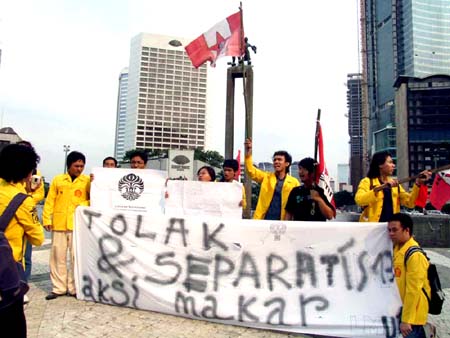
Separatism is a movement to obtain sovereignty and split a territory or group of people (usually the group with a keen national consciousness) from one another (or another country). The term is usually not accepted by the separatists themselves because they consider it rude, and chose a more neutral term sepertideterminasi themselves.
At its heyday, nationalism seems so deeply rooted in various walks of life in Indonesia. This can be easily seen in so many words 'my nation, my country, which I love' or 'for the sake of national and state', as it appears in almost every daily conversation to official state dialogue. Make sense of Indonesia, in the context of nationalism, is a unity between the nation (nation) as well as the state (state) (Dhakidhae, 2001: v). In it there is a solidarity of the nation-state (nation-state) from a wide arrangement of the tribal solidarity (ethnic). A great mystery behind the unification of diverse cultural entities that are very heterogeneous in an umbrella called the nation-state of Indonesia, have become commonplace in the national life. The slogan "Unity in Diversity", seems to be the ultimate adage that is able to reduce all the differences.

However, the emergence of various social conflicts in the era of the 1990s, seems to be a turning point in the journey of nationalism in Indonesia. After nearly half a century of triumphs in the archipelago of the earth after its independence, Indonesia nationalism seemed to crumble away without rest. Sense of pride as a unity of Indonesia seems to disappear, eroded by the waves of the spirit of tribalism and regionalism that was raging in some areas. Association of Indonesian nationality becomes less meaningful, and sunk by a very strong ethnic sentiment. The emergence of various shades of ethnic conflict, religion, and race (SARA) in Kalimantan, Maluku, and Poso, until a local revolt radical movement in East Timor, Aceh, South Moluccas, and Papua seems to be evidence of a fading sense of nationhood as well as a threat to the existence of Indonesia as a unified entity in a nation-state. Discourse of cultural separatism, anti-nationalism, Indonesia has become a phenomenon at once the question that kept looming. Could it be, nationalism, Indonesia has ended?
Examples of modern separatist movements in Indonesia is
• Republic of South Moluccas
• Free Aceh Movement
• Free Papua Organization
When examined, the emergence of separatist movements in Indonesia such as the GAM in Aceh, Maluku and RMS at OPM in Papua driven more by economic injustice felt by the people in these areas due to the failure of the Government in their welfare. In fact, such as in Aceh and Papua, natural resource wealth is overwhelming. Unfortunately, the wealth was enjoyed by more people and a handful of foreign companies.
Economic injustice as a trigger separatist movement has also been recognized by the Government. Vice President Jusuf Kalla, for example, has said that separatist movements in Aceh Darussalam (NAD), Papua, Republic of South Maluku (RMS), and the problem of Poso in Central Sulawesi unfinished up to now and the issue of terrorism is caused by economic injustice. Therefore, the firm Jusuf Kalla, the key to solve these problems is to create economic justice, in a sense, the welfare of the people of Indonesia must be truly realized. (Suarapembaruan.com, 23/11/05).

Tidak ada komentar:
Posting Komentar